mirror of
https://github.com/UpsilonNumworks/Upsilon.git
synced 2026-05-09 08:25:44 +02:00
[GH-ISSUE #89] Provide an easy way to simplify radiant angles #28
Labels
No labels
bug
duplicate
easy
enhancement
enhancement
fixed
fixed
good first issue
hard
invalid
pull-request
wontfix
wontfix
No milestone
No project
No assignees
1 participant

Notifications
Due date
No due date set.
Dependencies
No dependencies set.
Reference
starred/Upsilon#28
Loading…
Add table
Add a link
Reference in a new issue
No description provided.
Delete branch "%!s()"
Deleting a branch is permanent. Although the deleted branch may continue to exist for a short time before it actually gets removed, it CANNOT be undone in most cases. Continue?
Originally created by @Zaitara on GitHub (Nov 29, 2021).
Original GitHub issue: https://github.com/UpsilonNumworks/Upsilon/issues/89
Problem you'd like to fix
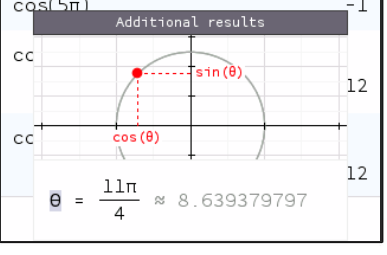
I'm always frustrated when I have a radiant angle which is not simplified, and when I want to know its value, belonging to ]0;2π]. The calculator is able to simplify it (it is only a modulo 2π operation), but does not provide a way to do it easily. The angle is not simplified when applying some trigonometrical functions such as cos, sin or tan in the advanced menu.
Screenshots
Here is an example, when writing cos(9π/4), I would expect it to give θ = π/4 (or 0.25π, basically the same) in the θ line
Describe the solution you'd like
I would like to be able to get an angle simplified for instance when using cos, sin or tan, like in the above menu in the θ line.
Describe alternatives you've considered
I've also considered adding a function in the toolbox to simplify an angle, which would basically give the same angle but between ]0;2π]. It is a good alternative in my opinion.
Additional context
N/A
@Lauryy06 commented on GitHub (Dec 8, 2021):
Thanks for the issue, I think I'll make theta equal to the main measure of the angle.
@Lauryy06 commented on GitHub (Feb 21, 2022):
For an angle like sqrt(5) x π, do you think it's better to simplify it to (sqrt(5) - 2) x π, at the risk of having a more complex formula in the end, or leave it in its original form and simplify only the rational coefficients of π (like 3/2) ?
@Lauryy06 commented on GitHub (Feb 21, 2022):
I implemented the second approach in
23a94b7f50.